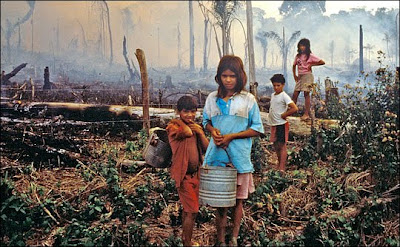
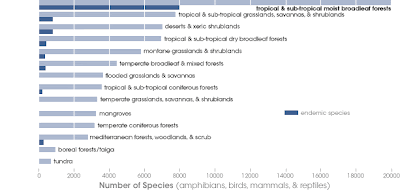
Although tropical forests cover only about 7 percent of the Earth’s dry land, they probably harbor about half of all species on Earth. Many species are so specialized to microhabitats within the forest that they can only be found in small areas. Their specialization makes them vulnerable to extinction. In addition to the species lost when an area is totally deforested, the plants and animals in the fragments of forest that remain also become increasingly vulnerable, sometimes even committed, to extinction. The edges of the fragments dry out and are buffeted by hot winds; mature rainforest trees often die standing at the margins. Cascading changes in the types of trees, plants, and insects that can survive in the fragments rapidly reduces biodiversity in the forest that remains. People may disagree about whether the extinction of other species through human action is an ethical issue, but there is little doubt about the practical problems that extinction poses.
First, global markets consume rainforest products that depend on sustainable harvesting: latex, cork, fruit, nuts, timber, fibers, spices, natural oils and resins, and medicines. In addition, the genetic diversity of tropical forests is basically the deepest end of the planetary gene pool. Hidden in the genes of plants, animals, fungi, and bacteria that have not even been discovered yet may be cures for cancer and other diseases or the key to improving the yield and nutritional quality of foods—which the U.N. Food and Agriculture Organization says will be crucial for feeding the nearly ten billion people the Earth will likely need to support in coming decades. Finally, genetic diversity in the planetary gene pool is crucial for the resilience of all life on Earth to rare but catastrophic environmental events, such as meteor impacts or massive, sustained volcanism(Lindsay,R).
Deforestation results in declines in biodiversity. The removal or destruction of areas of forest cover has resulted in a degraded environment with reduced biodiversity. Forests support biodiversity, providing habitat for wildlife moreover, forests foster medicinal conservation. With forest biotopes being irreplaceable source of new drugs (such as taxol), deforestation can destroy genetic variations (such as crop resistance) irretrievably.
Since the tropical rainforests are the most diverse ecosystems on Earth and about 80% of the world's known biodiversity could be found in tropical rainforests, removal or destruction of significant areas of forest cover has resulted in a degraded environment with reduced biodiversity.
Scientific understanding of the process of extinction is insufficient to accurately make predictions about the impact of deforestation on biodiversity. Most predictions of forestry related biodiversity loss are based on species-area models, with an underlying assumption that as forest are declines species diversity will decline similarly. However, many such models have been proven to be wrong and loss of habitat does not necessarily lead to large scale loss of species. Species-area models are known to overpredict the number of species known to be threatened in areas where actual deforestation is ongoing, and greatly overpredict the number of threatened species that are widespread.

It has been estimated that we are losing 137 plant, animal and insect species every single day due to rainforest deforestation, which equates to 50,000 species a year Others state that tropical rainforest deforestation is contributing to the ongoing Holocene mass extinctionThe known extinction rates from deforestation rates are very low, approximately 1 species per year from mammals and birds which extrapolates to approximately 23,000 species per year for all species. Predictions have been made that more than 40% of the animal and plant species inSoutheast Asiacould be wiped out in the 21st century. Such predictions were called into question by 1995 data that show that within regions of Southeast Asia much of the original forest has been converted to monospecific plantations, but that potentially endangered species are few and tree flora remains widespread and stable(wikipedia)
At the amazon, various bird species from the lower mountain slopes have colonised the new dry areas upslope, and many herptile species have declined in abundance or vanished. Three frog mortality events coincided with the three annual peaks in dry day frequency. There is circumstantial evidence that these declines are linked to increased activity of parasitic flies following frog concentrations around water sources. These changes serve to highlight the complex relationships between local climate, land use and species survival (Miles,L.J)
References:
Lindsay,Rebecca. Tropical deforestation. Nasa earth observatory; http://earthobservatory.nasa.gov
Miles,L.J. The impact of global climate change on tropical forest biodiversity in amazonia. http://etheses.whiterose.ac.uk/16/1/LJM_thesis_complete_text.pdf
Wikipedia; http://en.wikipedia.org/wiki/Deforestation
 people make their livings through subsistence agriculture, hunting and gathering, or through low-impact harvesting of forest products like rubber or nuts. Deforestation large scale by loggers or “outside people” could make social conflict. People will lose their land that will affect their live.


